LMS
LMS
Last updated on 20th May 2026| 11284

- Introduction SAP S/4HANA Explained for Beginners
- Understanding the HANA Database Revolution
- Core Differences from Legacy SAP ECC
- Key Business Modules in S/4HANA
- The Universal Journal Concept
- Real-Time Analytics and Reporting
- Simplification and Data Footprint Reduction
- Cloud Deployment Options
- Conclusion
Introduction – SAP S/4HANA Explained for Beginners
Stepping into the enterprise software world for the first time usually means hearing the term SAP S/4HANA constantly, but very few people actually take the time to explain what it is in plain English. At its core, SAP S/4HANA is the newest generation of enterprise resource planning software built by SAP, and it is designed to run exclusively on the SAP HANA database. Older systems used to store data on slow disk drives, forcing companies to run massive overnight batch jobs just to generate a simple financial report. SAP S4 HANA Training completely eliminates this delay by keeping all data in active memory, allowing businesses to process millions of records in fractions of a second. For beginners, thinking of it as a massive upgrade from a dial-up internet connection to fiber-optic speeds is a great mental model. Companies are spending billions of dollars migrating to this platform because it allows them to make instant business decisions based on live data rather than guessing based on yesterday’s numbers. Understanding this underlying speed and architecture is the absolute first step before you even think about learning specific modules or configuration steps. Staying proactive with foundational knowledge ensures stronger preparation, and focusing on architecture builds credibility. Over time, this mastery positions you as a fresher who can confidently explore SAP S/4HANA.
Understanding the HANA Database Revolution
To truly appreciate S/4HANA, you have to understand the database revolution that makes it possible. Traditional databases like Oracle or older SAP databases store information on hard disk drives. Every time a user runs a report, the system has to fetch that data from the physical disk, which takes time. SAP HANA flipped this concept by moving everything into RAM, which is essentially the computer’s short-term memory. Accessing data from RAM is thousands of times faster than reading from a disk. Furthermore, HANA is a columnar database, meaning it stores data by columns rather than rows and SAP S4 HANA Training. If a financial analyst only wants to see total sales numbers for a specific month, the database only reads that specific sales column, ignoring everything else. This combination of in-memory processing and columnar storage completely changes what is technically possible. It transforms the database from a dumb storage unit into an active, calculating engine that can crunch massive mathematical formulas instantly. For a beginner, knowing that HANA is an in-memory, columnar database is the most important technical concept you can grasp. Staying consistent with database fundamentals ensures stronger preparation, and focusing on in-memory concepts builds credibility. Over time, this mastery positions you as a fresher who can confidently understand SAP HANA’s role in enterprise systems.
Ready to Get Certified in SAP BASIS ? Explore the Program Now SAP BASIS Training Offered By ACTE Right Now!
Core Differences from Legacy SAP ECC
- Elimination of Aggregate Tables: In older SAP ECC systems, companies had to create secondary summary tables to make reports run faster. S/4HANA completely removes the need for these aggregate tables because the base database is so fast that it can calculate summaries on the fly.
- Simplified Data Model: Legacy SAP was notorious for having incredibly complex, redundant data tables spread across different modules thy Why SAP is high demand career option. S/4HANA collapses these tables, significantly reducing the total size of the database and making it much easier for developers to maintain.
- Modern User Experience: Older SAP systems looked like software from the 1990s with confusing transaction codes and cluttered screens. S/4HANA features the SAP Fiori design language, which provides a clean, app-like, web-based interface that actually looks modern.
- Built-In Predictive Analytics: Instead of relying on external data warehousing tools to predict business trends, S/4HANA has predictive capabilities built directly into its core processes, allowing it to forecast demand or flag late payments automatically.
- No More Batch Processing: In the past, companies had to wait for night-time processing windows to close their financial books. Because S/4HANA is so fast, it supports real-time closing, meaning finance teams can close the books on the last day of the month instead of waiting days into the next month.

Key Business Modules in S/4HANA
S/4HANA organizes all of a company’s operations into distinct functional modules, and knowing what these modules do is essential for any beginner. The most famous are the finance modules, SAP FI for financial accounting and SAP CO for controlling, which handle all the money flowing in and out of the business. Then you have SAP MM for materials management, which deals with purchasing raw materials and managing warehouse inventory. SAP SD handles sales and distribution, managing everything from customer quotes to shipping out the final product. Beyond these classics, S/4HANA introduces highly specialized modules like SAP Ariba for supplier relationship management and SAP SuccessFactors for cloud-based human resources. SAP Modules Every Fresher Should learn, you do not need to learn how to configure all of them. You simply need to understand how they connect. For example, you need to know that a sale made in SD instantly creates a financial entry in FI and reduces inventory levels in MM.
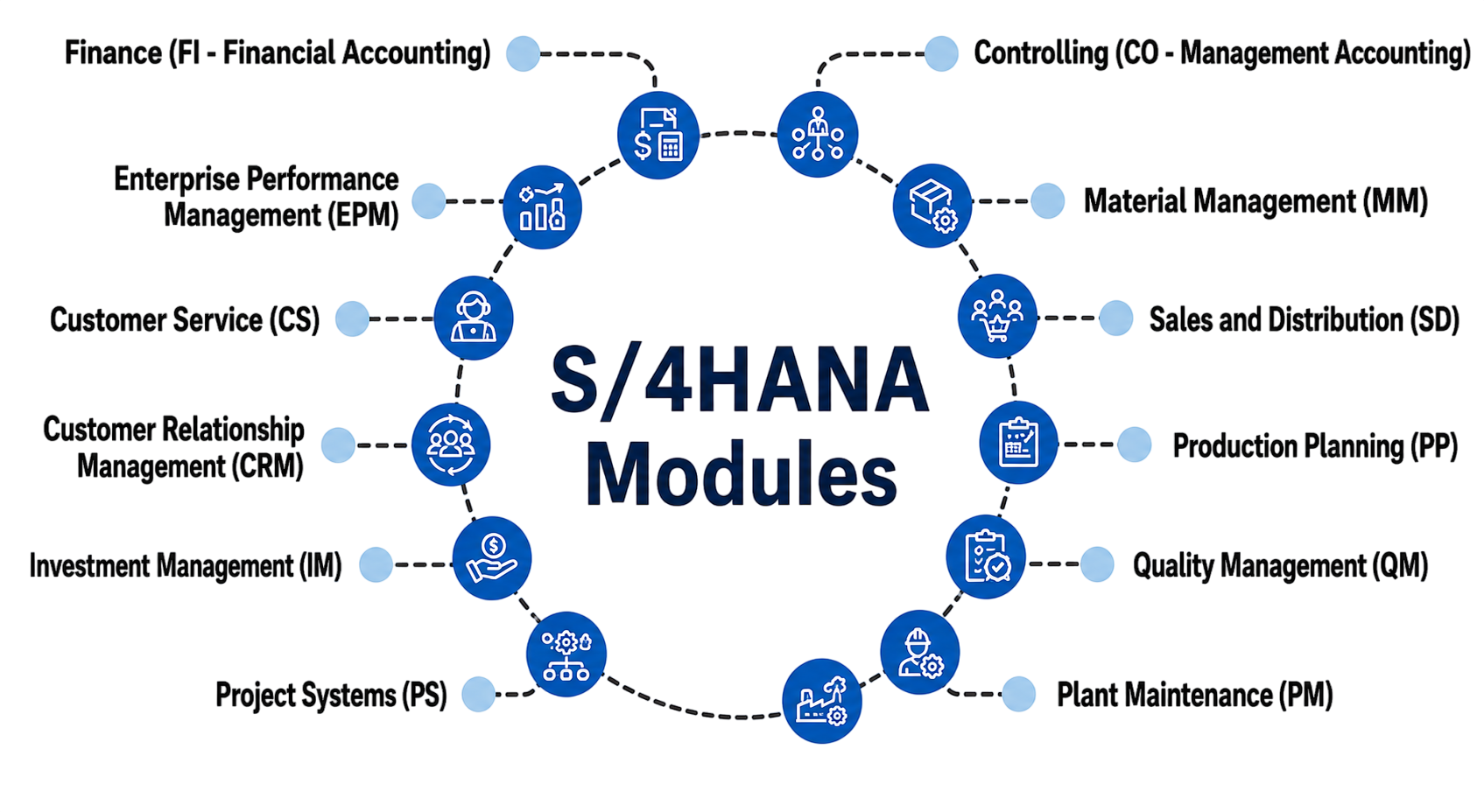
This integration is what makes the software so powerful for large corporations. Staying proactive with module understanding ensures stronger preparation, and focusing on integration builds credibility. Over time, this mastery positions you as a fresher who can confidently explore SAP S/4HANA modules.
Excited to Obtaining Your SAP BASIS Certificate? View The SAP BASIS Training Offered By ACTE Right Now!
The Universal Journal Concept
If there is one single technical feature that defines S/4HANA, it is the Universal Journal. In legacy systems, financial accounting and management accounting were completely separated. They had different tables, different currencies, and different reporting tools. Reconciling the two at the end of the month was a massive, painful headache for accountants. S/4HANA solves this by combining everything into one single table called the Universal Journal and know How to build a strong resume for SAP freshers. Every single financial transaction, whether it is a $10 office supply purchase or a million-dollar factory asset depreciation, is stored in this exact same place. This means there is zero discrepancy between financial and managerial accounting. You can pull a profit and loss statement for external legal reporting and a detailed cost center report for internal managers from the exact same dataset simultaneously. For beginners, understanding the Universal Journal is crucial because it fundamentally changes how you troubleshoot financial errors. Staying consistent with journal practice ensures stronger preparation, and focusing on unified reporting builds credibility. Over time, this mastery positions you as a fresher who can confidently manage SAP financial processes.
Real-Time Analytics and Reporting
Because the HANA database processes information instantly, S/4HANA completely changes how business leaders interact with their data. In the past, a CEO who wanted to see current global sales numbers had to request a report from the IT department, who would then run a heavy database query that might take hours to process. By the time the report was ready, the numbers were already outdated. S/4HANA integrates directly with modern analytics tools to provide real-time dashboards. Executives can open an app on their iPad and see live inventory levels, cash flow updates, and supply chain bottlenecks as they are happening. This capability empowers companies to be incredibly proactive. If a specific product is selling faster than expected in one region, the system can instantly trigger alerts to increase production now Top companies hiring SAP freshers . For beginners learning the system, understanding that the data is always live and updated means you have to be much more careful with your configurations. A single mistake in a master data record can immediately corrupt live dashboards across the entire company. Staying proactive with analytics ensures stronger opportunities, and focusing on accuracy builds credibility. Over time, this mastery positions you as a fresher who can confidently handle SAP reporting.
Are You Considering Pursuing a Gen AI Master’s Degree? Enroll For SAP BASIS Expert Masters Program Training Course Today!
Simplification and Data Footprint Reduction
One of the biggest selling points Data Footprint Reduction uses to convince companies to upgrade to S/4HANA is the concept of simplification. Over the last thirty years, companies using older SAP systems have customized their software to the point where it became a tangled mess of redundant code and obsolete data tables. S/4HANA acts like a massive spring cleaning. SAP systematically removed thousands of obsolete data fields, redundant tables, and outdated functions that were necessary in the old system but are completely useless in an in-memory database and differance using SAP FICO vs SAP MM vs SAP SD. This drastically reduces the overall size of the database, which in turn reduces cloud storage costs and hardware maintenance. For beginners, this simplification is actually a massive advantage. It means you are learning a cleaner, more logical system. You do not have to waste time learning archaic workarounds that were invented in 1998 to fix slow database speeds. The system forces companies to adopt standard best practices, making it much easier for a new consultant to understand how a client’s business processes are mapped. Staying consistent with simplification ensures stronger preparation, and focusing on best practices builds credibility. Over time, this mastery positions you as a fresher who can confidently work with SAP S/4HANA implementations in Data Footprint Reduction Data Footprint Reduction.
Set to Ace Your SAP BASIS Job Interview? Check Out Our Blog on SAP BASIS Interview Questions & Answer
Cloud Deployment Options
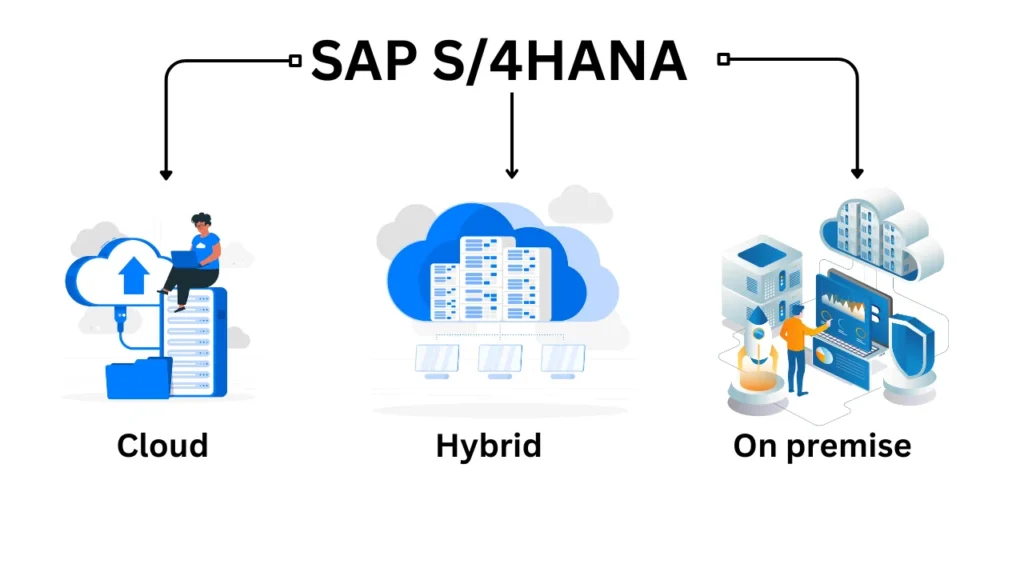
- On-Premise Deployment: Some large corporations prefer to keep everything internal. With the on-premise option, the company buys the hardware, installs the S/4HANA software in their own server rooms, and manages all the upgrades and security themselves. This offers maximum control but requires a massive IT budget.
- Public Cloud Editions: SAP offers fully managed cloud versions hosted on providers like AWS, Google Cloud, or Microsoft Azure. In this model, SAP handles the hardware maintenance, database updates, and security patches. Companies simply log in and use the software.
- Private Cloud Managed Services: This is a middle-ground approach where the hardware is physically located in a private data center, but SAP or a partner takes care of managing the infrastructure and SAP S4 HANA Training. It offers enhanced security compliance for banks or healthcare companies while reducing the burden on internal IT teams.
- Hybrid Deployments: Many massive enterprises use a hybrid approach. They might keep their highly sensitive financial core on a private server while running their less critical supply chain modules on the public cloud to save money and increase flexibility.
- The Rise of RISE with SAP: RISE with SAP is currently the most popular way companies buy S/4HANA. It is not just software it is a bundled subscription that includes the software, cloud infrastructure, migration tools, and business process consulting, making the transition much easier for beginners to understand from a project perspective.
Conclusion
Understanding SAP S/4HANA as a beginner is all about grasping the massive technological shift from slow disk-based storage to lightning-fast in-memory processing. The software is not just a visual upgrade; it is a complete architectural rewrite that forces companies to abandon messy legacy code and adopt clean, standardized business processes. By focusing your early learning on the HANA database concepts, the Universal Journal, and the core modules like FI, MM, and SD, you build an incredibly strong foundation. You do not need to become a database administrator to be successful here. You just need to understand how the speed of the database enables real-time reporting and simplifies the overall data model and SAP S4 HANA Training. As every major corporation in the world races to migrate to this platform before older systems lose support, the demand for professionals who understand these foundational S/4HANA concepts is only going to explode. Take the time to master these basics, and you will have a highly secure, lucrative career in enterprise software for decades to come.